AI Brand Visibility: A One-Page Fact Check for Service Firms
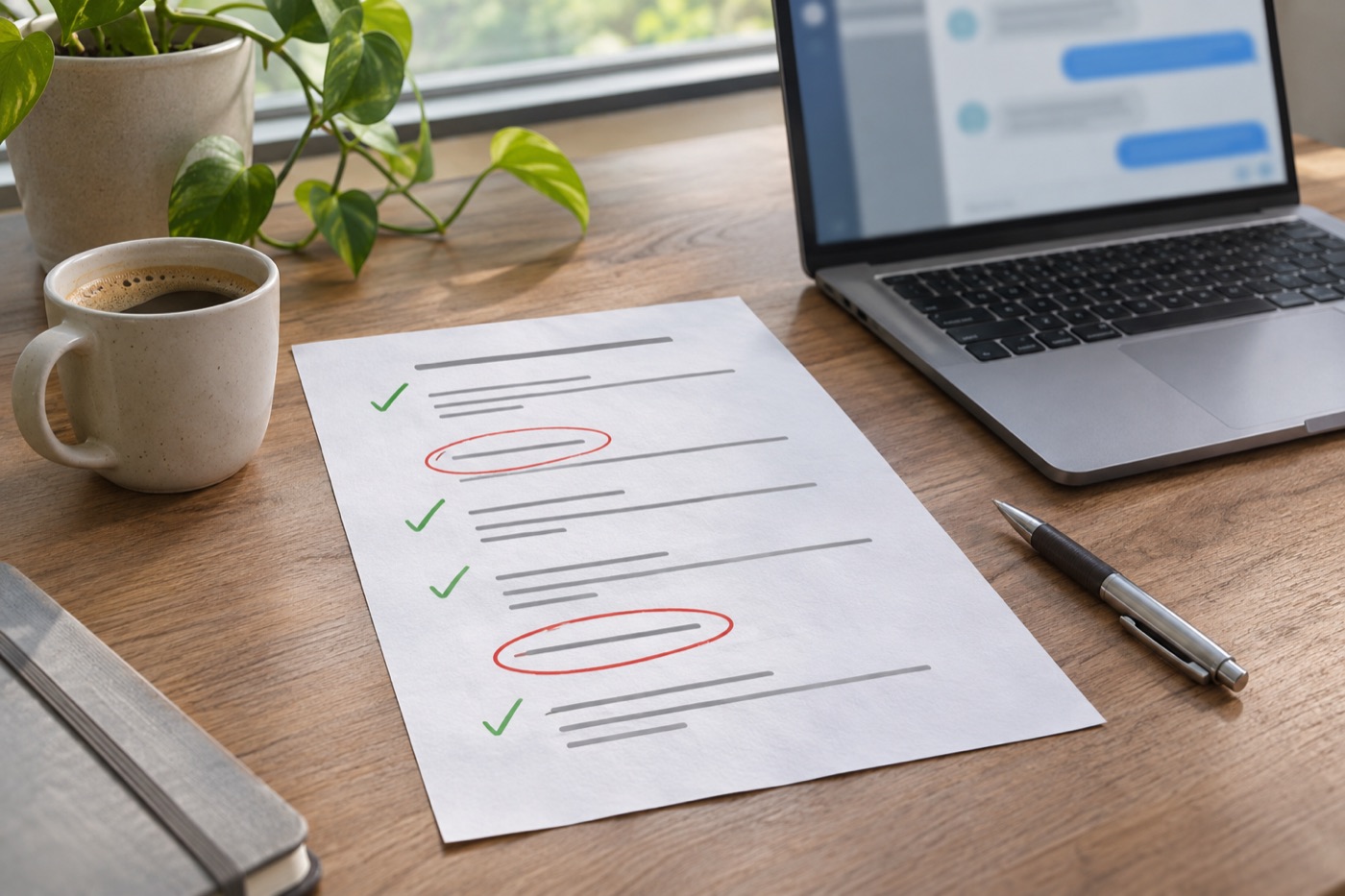
AI brand visibility is how often ChatGPT, Perplexity, Gemini, Claude, Google AI Overviews and AI Mode name your business, cite your pages and describe you correctly, both when a buyer asks who to hire and when they ask about you by name. If an engine says you dropped a service you still sell, you can lose that call and never hear about it. In BrightLocal's Local Consumer Review Survey 2026, a panel of 1,002 US adults, use of ChatGPT and other generative AI tools for local recommendations rose from 6% the year before to 45%. The check below gives you a marked-up list of what engines get right and wrong about your firm, and it needs no software.
Key points
- Grade each answer against a one-page sheet of facts you wrote, so every fact gets marked right, wrong or missing.
- A small test can't give you a visibility percentage you can trust, but it can surface wrong facts you can correct now.
- Fix wrong facts first, then gaps on your own site, then outside mentions.
What is AI brand visibility?
AI brand visibility is the way your business shows up inside answers from ChatGPT, Perplexity, Gemini, Claude, Google AI Overviews and AI Mode. It covers whether an engine names you, whether it cites your pages, whether it steers the reader toward you, and whether what it says about you is true.
Log named and cited separately. Semrush's AI Visibility Index notes that "A brand can be mentioned frequently without its website being cited as often, or cited frequently without being mentioned as often."
Why not just buy a tool and read the score?
You may get there later, but a score is a weak place to start. SparkToro's January 2026 study found less than a 1 in 100 chance that ChatGPT or Google's AI, asked the same question 100 times, gives the same list of brands in any two responses. Its write-up calls a visibility percentage reasonable "across dozens to hundreds of prompts run multiple times." Before you buy a tool, ask how many prompts it runs, how many times it repeats each, and whether it stores the full answers.
You won't run that volume by hand this week, and you don't need to. A wrong address in one answer is worth tracing today, whatever the next run says.
Don't panic over a thin showing on category questions either. A preprint from Ranqo, a company that tracks AI visibility, covered more than 100 brands on its platform from March to May 2026. On first runs, global household names appeared in 73% of relevant answers, mid-market and regional brands in 44%, and niche and small brands in 11%. Those are brands one vendor tracks, not a random sample of local firms, so read the gap as a direction and not your odds.
How do you check your AI brand visibility against a fact sheet?
When you finish, you'll have one sheet showing what each engine gets right, wrong or leaves out, and a ranked list of fixes.
- Write the fact sheet. Put down about ten facts a buyer would act on: your exact business name, services you sell, work you turn down, towns you serve, address and phone, licenses and how you charge.
- Write six questions. Four with your name: "Who is [name]?", "Is [name] any good?", "How much does [name] charge?" and "Does [name] serve [town]?" Two without it: "Best [service] for [client type] in [town]" and "[service] near me."
- Lock your conditions. Use the same device, location and sign-in state, with a fresh chat each time. Record the model shown and whether the answer listed sources.
- Ask each question twice in ChatGPT, Perplexity, Gemini, Claude and AI Mode. Run each as a Google search too, and log the AI Overview if one appears.
- Mark the sheet. Mark each fact an answer touches right or wrong, and missing if the question called for it and the answer skipped it.
- Trace every wrong fact. Open the cited pages and note the URL that says it, or write "no source found."
Hypothetical example: six questions, two runs each, on five engines comes to 60 answers, plus any AI Overviews, so block real time for it.
Save the full wording of each answer. The Ranqo preprint found that whether a brand is framed positively or negatively flips about 6.7 times more often than whether it is mentioned at all, so one friendly answer tells you little about the next.
What goes in the log?
Copy these columns into a spreadsheet, one row per fact tested:
`Date | Engine and mode | Signed in? | Location | Run # | Question | Named? | Your page cited? | Fact tested | Right, wrong or missing | What it said | Source URL | Fix | Recheck date`
Hypothetical example row (Firm A isn't a real firm): Nov 9 | Perplexity, default | signed out | your town | run 2 | "Does Firm A handle estate planning?" | Yes | No | Services | Wrong | "focuses only on business law" | an old directory profile | profile edit submitted | Dec 7
Hypothetical example: your sheet has 10 facts, and one engine gets 7 right, leaves 1 out and states 2 wrong, an old address and a dropped service. That leaves you two sources to find and one gap to fill.
What should you fix first?
Work down this table in order. Wrong facts come first because buyers may already be reading them.
| What your log shows | What to do this week |
|---|---|
| Wrong fact, source found | Correct that page or listing, make sure your site agrees, then rerun the same question |
| Wrong fact, no source found | State the true fact in plain text on your site and Business Profile, then recheck next month |
| Fact missing from answers | Answer it in plain text on your site: services, towns, how you charge |
| Named, but your pages aren't cited | Check the sources it does cite, and whether you have a page that answers the question directly |
| Cited, but not named | Make sure the cited page says your business name in plain sentences beside the service it describes |
| Right on name questions, absent on category questions | Run the five-day AI visibility check, then work through how to get recommended by AI as a local business |
Add reviews to your check as well. BrightLocal reports that 82% of consumers read AI-generated review summaries, so log any summary a platform shows for your business.
Do outside mentions matter for AI brand visibility?
They track closely with it in Ahrefs' data, though that doesn't prove cause and effect. Ahrefs' study of 75,000 brands, published December 2025, covered ChatGPT, AI Mode and AI Overviews. YouTube mentions showed the strongest correlation with AI visibility (about 0.737), branded web mentions ran from 0.66 to 0.71, and link metrics showed very weak correlations.
Two limits matter for a small firm. Ahrefs filtered for sites above a set Domain Rating whose top keyword drew at least 800 monthly searches, so your firm may look nothing like that sample. It also warns that the patterns don't mean improving these metrics will automatically boost your AI visibility.
So earn mentions after the fixes above, in places your buyers would see anyway: local press, a trade association directory, a chamber listing, or a YouTube explainer.
What do you do once the sheet is marked up?
Tag each answer by where it left you, using Vector Index's guide to getting recommended by AI. It defines the four positions an answer can put you in: absent, mentioned, cited and recommended. Open it with your sheet beside you and you'll see which answers only name you and which steer the buyer your way, so you can choose your first AI brand visibility fix. Vector Index also says it can't promise a recommendation and wouldn't trust anyone who did.
FAQ
Is AI brand visibility the same as AI visibility?
People use the terms loosely and they overlap. This check centers on whether engines describe your firm correctly. The five-day check goes wider on category questions like "best CPA near me." Run both.
Does regular SEO already cover this?
For Google, partly. Google's guidance on AI features says "There are no additional requirements to appear in AI Overviews or AI Mode" and that existing SEO fundamentals remain worthwhile. That covers Google's features only, so test ChatGPT, Perplexity, Gemini and Claude separately.
Is this worth doing if most of your work comes from referrals?
Yes. A referred buyer already has your name, so the name questions show what that buyer reads if they check you in an engine before calling.
How often should you recheck your AI brand visibility?
Monthly, with the same questions, engines and settings, and again after a correction goes live. Rerun the exact question that produced the wrong fact, so your AI brand visibility log shows whether the fix took.